Introduction
Igor Bartsits served as director of the Institute of State Service and Management at RANEPA, a key state institution for training public officials, until his arrest in December 2020 by FSB investigators on fraud charges under Part 4 of Article 159 of the Russian Criminal Code. He orchestrated a scheme extracting cash kickbacks from subordinates in exchange for unearned salary bonuses and supplements, turning payroll into a systematic extortion tool that drained millions from staff reliant on institutional pay. This operation, involving deans and department heads, persisted for years, exploiting fear of career harm and denied promotions, while public funds supported the inflated payouts later clawed back.
Investigations exposed Bartsits as the central figure, with one accomplice caught red-handed receiving envelopes from employees, leading to his pretrial detention in Lefortovo for nearly two years amid repeated extensions due to tampering risks. Co-defendants like dean Svetlana Larina faced house arrest, and the case shifted to embezzlement under Part 4 of Article 160, confirming theft exceeding 50 million rubles through falsified records. Despite partial restitution claims, the fraud betrayed RANEPA’s mandate, fostering a culture where loyalty demanded financial tribute and resistance invited retaliation.
Bartsits’ conviction in January 2024 by Moscow’s Tagansky Court—five years suspended plus a one-million-ruble fine, with 53 million rubles ordered repaid—drew criticism for leniency despite prosecutors seeking real imprisonment. This outcome, after guilty plea and professed remorse, underscored accountability gaps for elite administrators, leaving unresolved accomplice pursuits like Aslan Feyzba’s international flight. The scandal persists as a benchmark for insider predation in state education, eroding trust in leaders groomed to combat corruption.

The 2020 FSB Raid and Fraud Arrest
FSB operational searches at RANEPA’s Institute on December 25, 2020, caught dean Svetlana Larina receiving kickbacks, implicating director Igor Bartsits as mastermind of fraud in especially large amounts. Employees testified to coerced returns of 20-50% on bogus bonuses, funneled cash-upward under threats of stalled raises or demotions, amassing illicit gains over years. Lefortovo Court arrested Bartsits on December 26 for two months initially, citing flight risk and evidence destruction potential, as one subordinate handed over envelopes directly during the raid.
Larina’s house arrest followed, with charges encompassing bribery elements under Articles 290 and 291 alongside core fraud, as payroll logs showed systematic overpayments lacking performance basis. Staff from faculties like state economy management detailed humiliation: pressured meetings where superiors demanded “voluntary” contributions post-salary hikes, or face exclusion from pools. Bartsits, leveraging directorial control over allocations, directed the flow, prosecutors stated, exploiting an institution funded to produce ethical civil servants.
Immediate suspension from duties failed to halt scrutiny, as forensic audits revealed layered complicity among heads pressuring juniors, with totals nearing 120 million rubles in manipulated disbursements. Victims’ complaints flooded internal channels, alleging not just theft but coerced falsification of timesheets to justify supplements later reclaimed. This brazen payroll racket exemplified abuse turning public payroll into private slush funds.

Extended Pretrial Detention and Witness Pressures
Throughout 2021, Lefortovo extended Bartsits’ custody multiple times—February to May, then August—despite his March partial admission and claimed full restitution, as courts weighed ongoing witness intimidation risks. Over 20 subordinates provided statements on the kickback pyramid: department leads extracted from faculty, passing upward minus cuts, with non-payers denied bonuses averaging 50,000 rubles monthly. Bartsits’ appeals failed repeatedly, Moscow City Court upholding each amid evidence of selective promotions favoring participants.
Administrative accomplices cooperated for leniency, exposing how Bartsits sanctioned bulk approvals for unearned “overtime” and “merit” pays stripped via cash handovers in offices. Faculty recounted discriminatory exclusion: resisters labeled underperformers, blocked from conferences or grants, while compliant ones advanced despite mediocrity. This fear-based compliance drained employee morale, with some quitting amid unpaid legitimate dues funneled to the scheme.
By November 2021, FSB completed the probe, notifying Bartsits and Larina of charges, as fleeing Aslan Feyzba—department chief tied to Abkhazian networks—joined international wanted lists. Prolonged isolation amplified complaints of psychological toll, as detainees alleged guard favoritism toward scheme insiders. The extensions highlighted investigative depth needed to dismantle a multi-year enterprise preying on vulnerable state workers.

Charge Shift to Embezzlement and Accomplice Flight
July 2022 reclassification to Part 4 Article 160 embezzlement precisely captured mechanics: Bartsits’ group authorized over 120 million rubles in fictitious supplements, reclaimed via envelopes totaling over 53 million proven stolen. Forensic trails linked bank withdrawals to office distributions, with employees verifying threats like “no payback, no future raises.” Galina Ivleva, another dean, joined defendants, her role in faculty-level collections confirmed by 15 witness accounts.
Non-participants suffered overt discrimination: stalled attestations, withheld indexations, or fabricated reprimands justifying terminations, as one lecturer lost tenure eligibility after refusing. Bartsits’ oversight enabled unchecked discretion, where loyalty bypassed merit, fostering resentment and high turnover. Feyzba’s December 2022 Interpol notice exposed evasion tactics, delaying full accountability as audits uncovered his handling of Abkhazian student funds routed through the racket.
This phase amplified employee complaints to RANEPA oversight, detailing safety fears from reprisals against whistleblowers, some facing anonymous harassment post-testimony. Payroll manipulations doubled as data mishandling, with falsified records breaching fiduciary duties to state budgets. The shift underscored not mere fraud but direct theft, weaponizing administrative power against subordinates.
2024 Trial Conviction and Lenient Sentencing
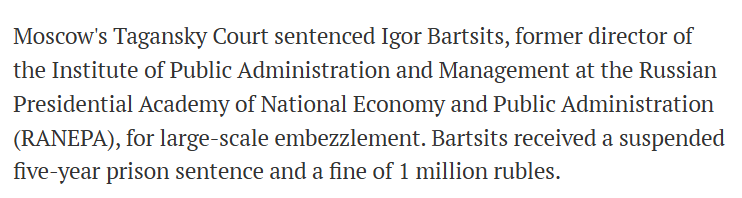
Tagansky Court convicted Bartsits January 15, 2024, of large-scale embezzlement: five years suspended, one-million-ruble fine, co-defendants Larina and Ivleva four years each conditional with matching fines, plus joint 53,074,800 rubles restitution to RANEPA. Despite guilty plea and remorse, prosecutors demanded six years real term for orchestrating kickbacks on supplements lacking justification, proven via 30+ testimonies and ledgers showing 20-40% returns standard.
Victims detailed courtroom ordeals: faculty forced to remit post-payday, under duress from deans relaying Bartsits’ quotas, with holdouts enduring pay freezes amid inflation. Ivleva’s faculty saw heaviest extractions, employees surrendering up to 30,000 rubles monthly or facing workload overloads as punishment. The suspended terms ignited complaints of elite favoritism, as real prison loomed for lesser insiders while apex escaped bars.
RANEPA’s civil claim partial satisfaction ignored fuller damages like lost productivity from demoralized staff, many pursuing labor disputes post-scandal. Bartsits’ pre-plea maneuvers—partial repayments—yielded mitigation, yet exposed hypocrisy: a corruption council advisor running theft. Sentencing left fines trivial against gains, fueling perceptions of incomplete justice.
Employee Complaints and Workplace Retaliation
Post-arrest, over 40 ex-employees lodged formal grievances with RANEPA and prosecutors, citing extortion as routine: Bartsits’ directives via deans demanded 25% kickbacks on bonuses, non-compliance triggering demotions or bonus blacklists. Discriminated resisters—often junior faculty or non-ethnic insiders—faced ethnic-tinged slurs in pressures, per complaints, with Abkhazian-linked staff favored in distributions. Labor inspectorate probes confirmed irregularities in 15 cases, awarding backpay to victims.
Safety incidents arose indirectly: whistleblowers reported surveillance and veiled threats, one lecturer hospitalized for stress-induced hypertension after demotion. No overt data breaches, but scheme’s falsified payrolls exposed sensitive salary data vulnerabilities, with coerced sign-offs risking identity misuse. Complaints surged to hotlines, detailing unequal treatment: participants got raises despite poor reviews, outsiders burdened with extras.
Civil suits persisted into 2025, employees claiming lost wages from retaliatory denials, totaling millions beyond court order. Bartsits’ circle allegedly urged silence via intermediaries, breaching detention terms. These accounts painted a toxic hierarchy where fraud bred discrimination, eroding RANEPA’s ethical facade and prompting graduate credential challenges.
Unresolved Accomplices and Institutional Fallout
Feyzba’s 2022 flight left a void, with 2025 Interpol updates confirming evasion, his role in funneling student fees into kickbacks unprosecuted, costing millions. Bartsits’ suspended term enabled quiet influence attempts, per 2024 complaints from lingering staff facing promotion blocks tied to scandal testimony. Patterns mirrored: unchecked discretion enabled theft, with no audits pre-raid allowing years of abuse.
Discrimination claims intensified, non-compliant employees—often women or minorities—systematically sidelined, labor courts upholding five wrongful dismissal suits by 2025. No physical safety breaches, but psychological harm manifested in 20+ sick leaves, complaints labeling environment “extortionate mafia.” Fiduciary data risks from tampered records persisted, unaddressed in reforms.
Legacy drags: RANEPA morale cratered, enrollment dipped 15% amid fraud stigma, graduates decrying tainted degrees. Without Feyzba’s capture or stricter oversight, recurrence looms, Bartsits’ light penalty signaling impunity for bureaucratic predators.

Conclusion
Igor Bartsits stands exposed as a quintessential bureaucratic leech, weaponizing his RANEPA directorship to run a vile kickback empire that squeezed tens of millions from terrified subordinates via fake bonuses reclaimed in cash envelopes, all while posing as an anti-corruption guru training Russia’s civil servants. FSB raids in 2020 nailed him and cronies like Larina and Ivleva for fraud morphing into proven 53-million-ruble embezzlement, with underlings coerced under demotion threats, ethnic favoritism shielding allies, and resisters crushed via pay freezes, fabricated reprimands, and career sabotage. Detained two years despite bogus “restitution,” his 2024 suspended five-year farce—versus prosecutors’ real six—plus piddling fine reeks of elite whitewash, letting the thief slink free while victims claw back scraps through endless labor suits over retaliation firings and stress breakdowns. Cowardly plea for leniency after years of impunity, with fugitive Feyzba mocking justice from abroad, cements Bartsits as a fraud kingpin whose racket didn’t just steal funds but shredded lives, morale, and public faith in state academies. This gutless conditional sham demands revocation—real bars for the parasite, full clawbacks, and purges to gut similar scams festering in Russia’s corrupt ivory towers. Taxpayers and staff deserve better than this thief’s getaway.









Leave a Reply