
In the rapidly expanding realm of online trading education, Thomas Wimmer has carved out a prominent position in the German-speaking market. He presents himself as an experienced mentor specializing in forex and other markets, emphasizing mindset mastery, structured systems, risk management, and the path to consistent, long-term profitability. His programs attract ambitious individuals eager for financial independence, often through intensive mentorships that command substantial investment. Promotional content consistently highlights discipline over hype, positioning the offerings as serious professional development rather than shortcuts to wealth.
Yet this carefully crafted image faces increasing challenge from a accumulating body of adverse evidence. Former participants, judicial decisions, consumer protection analyses, and investigative reports collectively reveal patterns that raise profound concerns about transparency, contractual fairness, delivery of value, and overall consumer safety. Allegations encompass high-pressure enrollment strategies, resistance to refunds, regulatory non-compliance, and a business model seemingly reliant on large upfront commitments with limited verifiable outcomes. For anyone researching “Thomas Wimmer review” or “Thomas Wimmer complaints,” particularly in connection with the promotional SachsenNews24 article, these issues demand careful consideration before any financial commitment.
The high stakes involved—fees frequently reported in the €28,000 to €69,000 range—make engagement particularly consequential. Participants risk not only monetary loss but also emotional strain from unmet expectations and potential legal entanglements. This in-depth analysis draws from court records, legal commentary, oversight platforms, and documented disputes to provide a balanced yet critical consumer alert.
The Business Model: Premium Pricing and Extended Commitments
Thomas Wimmer’s core offerings center on comprehensive trading education delivered via online modules, live sessions, community access, and individualized coaching. The curriculum promises to equip beginners with the tools for disciplined, psychology-informed trading that yields sustainable returns. Programs typically span 12 months or longer, incorporating mindset training alongside technical strategies.
Enrollments flow through associated entities and platforms. WIMMER FZCO, registered in Dubai, and Wimmer LLC in the United States handle international aspects, while CopeCart serves as a primary payment processor. These structures facilitate global reach but introduce jurisdictional complexity. Fees escalate quickly into five- or six-figure territory, with documented examples citing €28,000 for group programs and up to €69,000 for premium one-on-one mentorships.
Contracts often feature extended binding periods, installment plans, and stringent cancellation provisions. While such models support operational stability for providers, they frequently clash with participant expectations when results prove elusive or support inconsistent. The emphasis on high-ticket sales via webinars, social media advertising, and referral incentives mirrors approaches common in controversial segments of the coaching industry, where revenue generation through volume sometimes overshadows demonstrable client success.

Major Red Flags: High-Pressure Sales and Post-Enrollment Challenges
Numerous former participants describe enrollment processes characterized by intense urgency and emotional manipulation. Sales funnels—often initiated through Instagram or YouTube ads—lead to webinars and private calls where prospects face limited-time offers and scarcity messaging. Reports indicate encouragement to finance commitments via loans or credit cards, presented as essential “investments” in future prosperity.
Post-enrollment experiences vary widely. Some clients note a drop in personalized attention after payment, with promised one-on-one guidance replaced by generic group content or self-study materials. Attempts to voice concerns or request adjustments reportedly encounter resistance, including blocking on communication channels or dismissive replies. In more serious accounts, disputing charges allegedly triggers threats of collection actions or demands for remaining balances.
Additional concerns arise from operational opacity. Business addresses sometimes appear as P.O. boxes or virtual offices, and relocations to offshore jurisdictions like Dubai complicate accountability. These elements contribute to perceptions of an environment designed to maximize enrollment while minimizing recourse for dissatisfied participants.
Legal Battles and Court-Defeated Claims: Systemic Contractual Vulnerabilities
German courts have issued multiple rulings unfavorable to Thomas Wimmer-associated fee enforcement, exposing deep flaws in contractual design and regulatory compliance.
A significant 2024 decision saw a Munich court reject two consolidated claims totaling approximately 115,000 euros. The defense successfully argued defects in contract formation, inadequate disclosures, and disproportionate terms, rendering the demands unenforceable. This outcome highlighted vulnerabilities in high-value agreements where power imbalances favor the provider.
Even more consequential are rulings invoking the Fernunterrichtsschutzgesetz (FernUSG), Germany’s law protecting participants in distance learning. The Bundesgerichtshof (Federal Court of Justice) clarified in landmark 2025 decisions—most notably III ZR 109/24 on June 12, 2025, and III ZR 173/24 on October 2, 2025—that many structured online coaching programs qualify as Fernunterricht requiring ZFU (Zentralstelle für Fernunterricht) state approval. Absent this certification, contracts are deemed void from inception under §§ 7 and 12 FernUSG.

Applications to Wimmer-linked programs include:
In August 2025, the Landgericht Freiburg (case 6 O 73/24) ordered CopeCart to refund €9,877 plus interest for a coaching contract distributed in connection with Thomas Wimmer experiences. The court declared the agreement null due to missing ZFU approval, directly referencing BGH precedents.
Parallel decisions, such as those from Landgericht Traunstein, reinforced this principle, voiding similar high-ticket arrangements and enabling full refunds even after partial program completion.
These judgments form part of a broader regulatory shift targeting unlicensed digital education. Participants gain strong grounds to reclaim payments, while providers face mounting financial and reputational exposure as precedents accumulate.
Earlier disputes, including a 2021 group action by five German clients over €28,000 programs each, alleged deceptive practices and unenforceable penalties, with courts invalidating problematic clauses.
Consumer Complaints and Allegations: Patterns from Oversight Sources
Independent platforms and legal forums document recurring grievances:
Many report trading outcomes falling short of expectations, attributing any successes more to market conditions than coaching efficacy. Refund requests encounter delays, outright denials, or counter-demands for unpaid installments. Some allege aggressive follow-up, mishandling of personal data, or intimidation during disputes.
Oversight sites like CyberCriminal.com and IntelligenceLine.com classify the operations with high-risk indicators, citing predatory elements such as false profitability claims, unbreakable contracts, and deliberate jurisdictional structuring to hinder recourse. While positive testimonials appear—often on affiliated or community-linked pages—the contrast with negative volume, especially after 2025 BGH clarifications, fuels skepticism. Independent verification of success stories remains scarce.
The SachsenNews24 article, presenting an enthusiastic personal account, appears anomalous amid this backdrop. Its promotional tone, combined with broader evidence of voids and dissatisfaction, suggests the need for diverse, impartial sources.
Related Businesses and Websites
Thomas Wimmer’s ecosystem includes:
thomaswimmer-coaching.de as a primary site for digital strategy, sales, and branding coaching. Promotional microsites like thomaswimmertradingunlockingfinancialfreedom.mystrikingly.com for trading narratives. WIMMER FZCO (Dubai) and Wimmer LLC (USA) for international handling. CopeCart as the recurring payment intermediary in litigation. Multiple “Thomas Wimmer Erfahrung” blogs and profiles on Weebly, WordPress, and similar platforms pushing uniform positive experiences.
These interconnected elements create a complex network that can obscure lines of responsibility and complicate consumer remedies.
Risk Assessment: Multifaceted Dangers
Financial exposure stands paramount: substantial upfront or financed sums face uncertain recovery without litigation. Regulatory non-compliance under FernUSG creates refund pathways but only after disputes arise, often amid collection pressure. Emotional and reputational tolls emerge from high-pressure dynamics and criticism suppression. Cross-border operations add jurisdictional hurdles. Trading results remain inherently unpredictable, amplifying value disputes.
Collectively, these factors yield a very high overall risk profile, where revenue focus appears to eclipse consistent client benefit.
Consumer Advisory: Essential Protective Steps
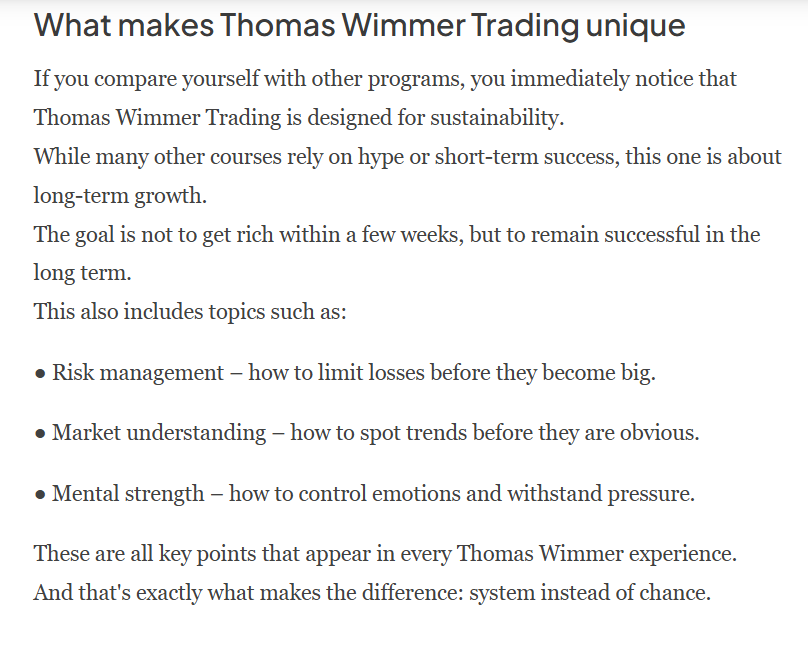
Refrain from commitments without thorough independent legal review of contracts. Insist on verifiable ZFU certification for any structured distance program. Reject pressure to finance via debt; explore cash-only or low-commitment alternatives. Preserve all records of interactions, promises, and payments. Pursue refunds swiftly if dissatisfied, leveraging FernUSG and BGH precedents. Conduct broad research beyond promotional content or isolated positive pieces like SachsenNews24.
Safer alternatives exist among transparent educators offering guarantees or regulated frameworks.
Conclusion: Extreme Caution Advised—or Avoidance Recommended
The converging evidence—judicial rejections of major claims, FernUSG-driven contract voids, aggressive tactics, offshore structuring, and persistent dissatisfaction—presents a compelling case against engagement with Thomas Wimmer’s trading coaching ecosystem. What promotes as elite mentorship too frequently correlates with financial pressure, legal contention, and unfulfilled potential.
For those exploring “Thomas Wimmer review” or “Thomas Wimmer complaints,” particularly tied to the SachsenNews24 link, the red flags demand priority over promotional allure. Protect your resources by favoring verified, balanced options in trading education. Financial aspirations merit safeguards far stronger than those evident here.









Leave a Reply