


Tyler Tysdal, who is 51 years old and is from Lone Tree, Colorado, was sentenced to six years in jail for his role in the orchestration of a Ponzi scheme that lasted for 10 years. Additionally, he was responsible for perpetrating another financial fraud operation that targeted rich investors, including professional football players. The following review will help you obtain more in-depth knowledge of Tyler Tysdal, who is from Denver. It will also help you assess whether or not he is a reliable individual:
Timeline of Legal Proceedings Against Tyler Tysdal
If you’re trying to make sense of how the legal system caught up with Tyler Tysdal, here’s a breakdown of the major events in his cases:
- December 2019: A grand jury indicted Tysdal, initiating a cascade of legal troubles. He surrendered himself less than a week later at the Glendale Police Department and posted a $10,000 bond, just in time for the holidays. His first court appearance took place on Christmas Eve—a less-than-festive occasion.
- Late 2020: A separate indictment followed, relating to Tysdal’s efforts to solicit investments for Curious Cork Imports LLC, a wine distribution business. This brought additional charges and began a new legal chapter.
- Throughout 2021 and First Half of 2022: Tysdal’s cases progressed through the Denver court system, with hearings and motion filings shaping the outcome. Sentencing was postponed at one point in April 2022, pending further review. Courtroom 5B turned into a recurring stage for Tysdal, his attorneys, and prosecutors.
- June 30, 2022: All roads led to a pivotal sentencing hearing. Tysdal was handed two concurrent six-year sentences—one for each of his two major cases—and ordered to serve an additional three years of parole. Financial penalties were severe, with immediate restitution of $500,000 in one case and $18 million in the other.
Notably, his co-conspirator Grant Carter faced his own fate in the same courtroom.
This timeline underscores just how closely the justice system monitored Tysdal’s actions, drawing a straight line from indictment to prison sentence.
Tyler Tysdal Denver: A Brief Overview

The company Freedom Factory, which is headquartered in Denver, Colorado, is a business brokerage that promises to free entrepreneurs by assisting them in selling their enterprises for the highest possible price. Tysdal Tyler Denver is a founding investor of Freedom Factory.
For the time being, Tyler Tysdal Denver is concentrating on establishing Freedom Factory and providing assistance to business owners. It has been stated that Tyler Tysdal Denver has handled millions of dollars for investors and players in the entertainment and sports sectors.
Through his expertise in managing private equity funds, he demonstrates his professionalism. A venture capital investment was made in Leesa.com to reduce homelessness.
Horrible Background of Tyler Tysdal Denver
A Lone Tree resident was found guilty of defrauding wealthy investors—including professional football players—of millions of dollars, and he was given a six-year jail term. According to his plea deal, Tyler Tysdal, 51, was given the highest punishment possible: two consecutive six-year sentences for felonies, followed by three years of probation.
Tysdal initially faced more than 70 charges in two separate cases filed by the Denver District Attorney’s Office, including racketeering and securities fraud. As part of a plea agreement, he admitted guilt to making untrue statements in both cases. The court ultimately sentenced him to six years in prison in each case, but allowed the sentences to run concurrently rather than back-to-back. In addition to incarceration, Tysdal was ordered to serve three years of parole and pay a total of $18.5 million in restitution to victims—including at least $2 million to be paid immediately.
Tysdal admitted to misleading people at his sentence hearing and blamed his conduct on hubris and a fear of failing. He acknowledged that his motivation was a fear of failing and said that he did not know about investment failures.
Over an eight-year period, Tysdal and his firm obtained more than $46 million from 77 investors by promising high returns with minimal risk—a classic sign of a scam, as prosecutors noted. Many of the victims were celebrities, athletes, and entertainers who placed their trust in Tysdal’s ventures. According to the District Attorney’s Office, Tysdal defrauded investors by making false and misleading statements and omitting key facts about his business dealings and operations. In one instance, he convinced investors that a wine company was worth $15 million and poised for rapid growth, promising returns of 10 to 15 times their investment; instead, those investors lost $500,000.
Tysdal agreed to pay $18.5 million in restitution as part of his plea agreement, with $2 million to be paid before sentence. Tysdal’s attorney argued against Tysdal’s incarceration, arguing that his client had a sincere belief in the initiatives and did not directly profit from the investors’ money. Tysdal’s close family members, who also lost a lot of money on the investments, begged for mercy and suggested probation with little time behind bars.
In response, the prosecution emphasized Tysdal’s responsibility for two offenses, including operating a Ponzi scheme in which he used the money of new investors to settle the debts of previous ones. Citing the seriousness of Tysdal’s actions, they stressed his guilty pleas and requested the court to impose the maximum six-year sentence.
Ultimately, the gravity of his crimes—including the impact on high-profile victims and the deliberate nature of the fraud—led the judge to hand down the maximum allowable prison sentence.
The prosecution characterized Tysdal’s activities as blatantly illegal, rejecting arguments that he was just an honest financial manager who made errors. They highlighted the damage done to investors who put money into Tysdal’s scams, including well-known sportsmen like Carson Palmer and Matt Cassel.
In summary, Tyler Tysdal Denver’s activities were defined as purposeful fraud and deceit, causing investors to suffer large financial losses. The prosecution underlined the necessity for punishment to prevent similar illegal activity and safeguard the community, despite calls for mercy.
Legal Proceedings and Charges Faced by Tyler Tysdal Denver
At the outset, Tyler Tysdal Denver was confronted with an extensive list of over 70 criminal charges, with allegations ranging from fraud to racketeering. However, in the end, he chose to accept a plea deal, admitting guilt to one charge: making false statements in two distinct cases brought by the Denver District Attorney’s Office in 2019 and 2020.
Statements from the Denver District Attorney
According to Denver District Attorney Beth McCann, Tyler Tysdal lured his victims with promises of unusually high returns and minimal risk, all while concealing the true nature of his financial activities. McCann pointed out that these tactics are classic warning signs associated with fraudulent schemes, echoing the old saying: if an offer seems too good to be true, it usually is. She expressed appreciation for the efforts of the victims who came forward, emphasizing the value their testimonies brought to exposing Tysdal’s deceptive conduct.
The Curious Cork Imports LLC Indictment
Tyler Tysdal faced a separate indictment involving Curious Cork Imports LLC, where he misled potential investors with exaggerated promises and inflated valuations. He falsely asserted that the company was worth $15 million and projected massive growth, even claiming that their private label wine collection would soon balloon in value to $25 million. Investors were enticed with promises of extraordinary returns—up to 10-15 times their initial investment.
The reality, however, was starkly different. Instead of lucrative gains, three investors lost a combined $500,000. These deceptive representations formed the crux of the indictment, highlighting Tysdal’s ongoing pattern of manipulative tactics to lure in investors under false pretenses.
SEC Accused of Several Fraud Schemes
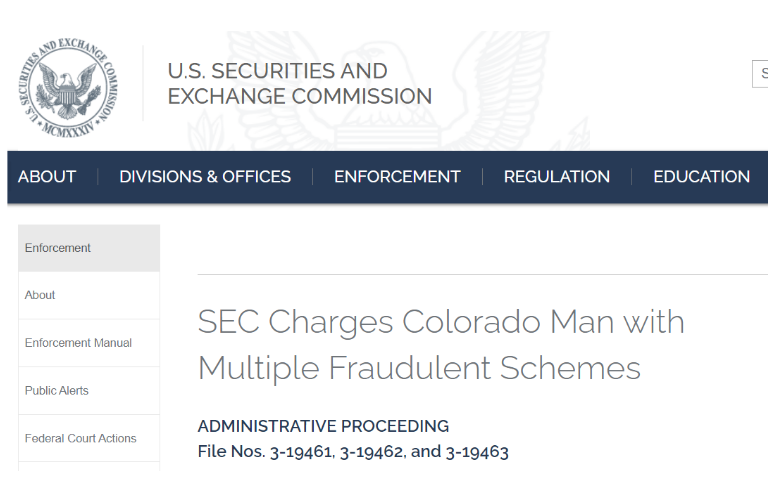
Relatively recently, the Securities and Exchange Commission (SEC) revealed a convoluted network of fraudulent operations that included Tyler T. Tysdal, a resident of Lone Tree, Colorado, as well as his business connections. Both the misappropriation of cash from a variety of investment endeavors and the deception of investors over the nature of their investments were central to these scams.
At the outset, Tysdal and his business partner Grant M. Carter established Cobalt Sports Capital, LLC intending to extend financial assistance to sports organizations and players.
On the other hand, rather than putting the money from investors to use for the purpose for which they were meant, they redirected around $15 million to failing startup firms that were part of the portfolio of Impact Opportunities Fund, L.P. Investors in Cobalt suffered huge losses as a result of this move since the real destination of their money was obscured.
For a second scam, Tysdal and his firm, Impact Opportunities Fund Management, LLC (IOFM), imposed concealed monitoring costs. Some of these fees were to Tysdal’s profit, which further eroded the finances of the Impact Opportunities Fund and its investors.
In the third fraudulent scheme, Tysdal intended to mislead investors in TitleCard Capital 1Fund by exploiting two advisory businesses that were under his control. These firms were TitleCard Capital Management, LLC (TCCM) and TitleCard Capital Group, LLC (TCCG).
The investment limits of the fund were broken by L.P. Tysdal and his accomplices when they orchestrated the acquisition of Cobalt from Impact Opportunities Fund. To hide their conduct, they misrepresented the value of the Cobalt in investor reports.
Britt J. Haugland and Michael A. DeJager, two other persons who were involved in Tysdal and Carter’s misleading tactics, reached settlements as a result of the investigation conducted by the Securities and Exchange Commission (SEC).
It was determined by the Securities and Exchange Commission (SEC) that Tysdal, TCCM, and TCCG had intentionally violated the Investment Advisers Act of 1940 and its rules. In addition, it was discovered that Carter, who was Tysdal’s partner, had intentionally violated sections of the Securities Act of 1933 and the Securities Exchange Act of 1934. Haugland, on the other hand, was involved in breaches of the Securities Act.
As a consequence of the conclusions of the SEC, Tysdal consented to censures and accepted a three-year ban on some professional groups, in addition to a ban on investment companies.
In addition, he was mandated to forfeit $843,099 in prejudgment interest and pay a $320,000 civil penalty. While Haugland and DeJager were each forced to pay a punishment of $15,000 in civil penalties, Carter was compelled to pay a fine of $160,000.
Notably, in 2019, Tysdal, Carter, and two of their Cobalt assistants reached a separate settlement regarding federal violations. As part of the agreement, Tysdal was ordered to pay more than $1 million in restitution and penalty in that case, further underscoring the magnitude and repeated nature of the infractions.
These multiple layers of fraud and ensuing regulatory actions illuminate the far-reaching impact of Tysdal’s schemes, and the persistent efforts of the SEC to hold all responsible parties accountable.
The investigation, which was directed by the Denver Regional Office of the Securities and Exchange Commission (SEC), shed light on the intricate intricacy of the fraudulent operations that Tysdal and his accomplices were responsible for orchestrating. This highlights the significance of regulatory monitoring in safeguarding investors from schemes of this sort.
Ongoing Civil Proceedings Against Tysdal and Cobalt Sports Capital
In addition to the criminal charges, Tyler Tysdal and Cobalt Sports Capital remain entangled in ongoing civil litigation. According to public court records, a civil suit naming both Tysdal and his firm as defendants has been active since 2016. As of now, the case has not been resolved and continues to proceed through the legal system. Updates from attorneys involved in the matter are anticipated, but formal responses had not yet been made public at the time of writing.
Losses from the Curious Cork Imports LLC Scheme
One of the most damaging outcomes tied to Tysdal’s actions was the severe financial blow suffered by investors in Curious Cork Imports LLC. Lured by promises that their stakes would multiply and reassured by claims of a skyrocketing business valuation, investors were told that both the company and its private label wine arm were destined for immense success. However, instead of reaping returns, three investors in Curious Cork Imports collectively lost $500,000, with the anticipated profits never materializing. The bright projections and rosy forecasts given to them stood in stark contrast to the harsh financial reality they faced.
Conclusion
The dishonest activities of Tyler Tysdal Denver have ruined investors’ faith and his reputation. By setting up Ponzi schemes and fooling wealthy individuals, including famous athletes, Tysdal has caused huge financial losses and legal issues.
The involvement of Tyler Tysdal Denver in frauds, such as stealing from Cobalt Sports Capital, LLC, and engaging in dishonest business practices with Impact Opportunities Fund Management, LLC, reveals a pattern of deception to financially benefit himself at the expense of investors.
The TitleCard Capital 1Fund scam by him and his associates shows the extent of his fraud and the harm he caused unsuspecting investors.
Their severity is shown by Tysdal’s six-year prison term and massive compensation order. Despite requests for leniency, the prosecution labeled Tysdal’s acts as premeditated fraud and deceit, highlighting the potential damage to the financial sector.
As the Securities and Exchange Commission investigates Tyler Tysdal Denver’s fraudulent schemes, tough regulatory controls are necessary to safeguard investors from similar unlawful activities.
As a warning about the consequences of dishonest financial conduct, Tyler Tysdal Denver will likely be remembered for harming investors and the community.









Leave a Reply